Salvagnini at EuroBLECH 2026: Lead the Change takes shape in two complementary production architectures
Published: | News: EuroBLECH, Salvagnini

At EuroBLECH 2026, Stand D94, Hall 11, Salvagnini presents the Flexible Smart Line S4+P4 and the Flexible Smart Job Shop: two architectures coordinating technologies, automation and software according to different logics, making production more adaptable, autonomous and predictable.
In an industrial scenario in which change is no longer an option but a permanent condition, the real challenge is not to react but to manage it. And this is where Salvagnini’s presence at EuroBLECH takes shape.
Adopting advanced, automatic and sustainable systems that reduce dependency on specialist skills and make production more accessible and dynamically adaptable, helps to improve the ability to generate value and resilience in unpredictable situations. The recipe is to intervene along the entire production flow with adaptive technologies, multi-level automation and software, accompanying each step of the system life cycle with tailored services. This approach reduces waste, minimizes or eliminates WIP (work in progress), limits downtimes and improves downstream operations simply and automatically. In other words, it makes the production capacity more efficient, predictable and sustainable.
This direction is reflected in Lead the Change, Salvagnini’s new promise presented in Hanover. More than just a slogan, it is a clear industrial strategy declaration: it expresses the company’s intention to continue to tangibly contribute to the development of sheet metal processing production systems, and, at the same time, refers to the responsibility of every company to actively define its process of change, choosing technologies that help to face the future with greater awareness, serenity and autonomy.
It is a cultural change, even more than a technological one. The focus shifts from the machine to the work flow: the value is not given by the sum of the individual technologies, but rather by the ability to adapt and increase the efficiency of the production process as a whole. Competitive performance is no longer based on individual performance but on the continuous communication between the various phases: training, programming, cutting, forming, bending, logistics, maintenance. A whole that, in order to work to the best of its potential, must be managed as a single production organism. The factory solutions presented at EuroBLECH, stand D94, Hall 11, translate this vision into two complementary architectures. Flexible Smart Line coordinates punching and shearing and panel bending in a continuous flow; when production requires, Flexible Smart Job Shopconnects laser cutting, sorting, logistics, robotised panel bending and bending. In both cases, automation and software turn complexity into a controllable, adaptable and more predictable process.
They sum up corporate values and vision that do not follow sector trends but rather help to define them. They do not simply respond to market demands but aim to build a continuous communication with those who produce, invest and compete every day. Managing a change of this scope requires long-term vision and coherent choices. In this sense, Salvagnini maintains its own distinctive position: a company ownership that continues to invest in technological development and customer relations, guaranteeing stability, continuity and presence over time. These are increasingly key elements in a continuously evolving market.
The new features in a nutshell
- The FLOW software, which manages FSL S4+P4 with a range of production strategies and a digital twin to compare job queues and scenarios before launching production.
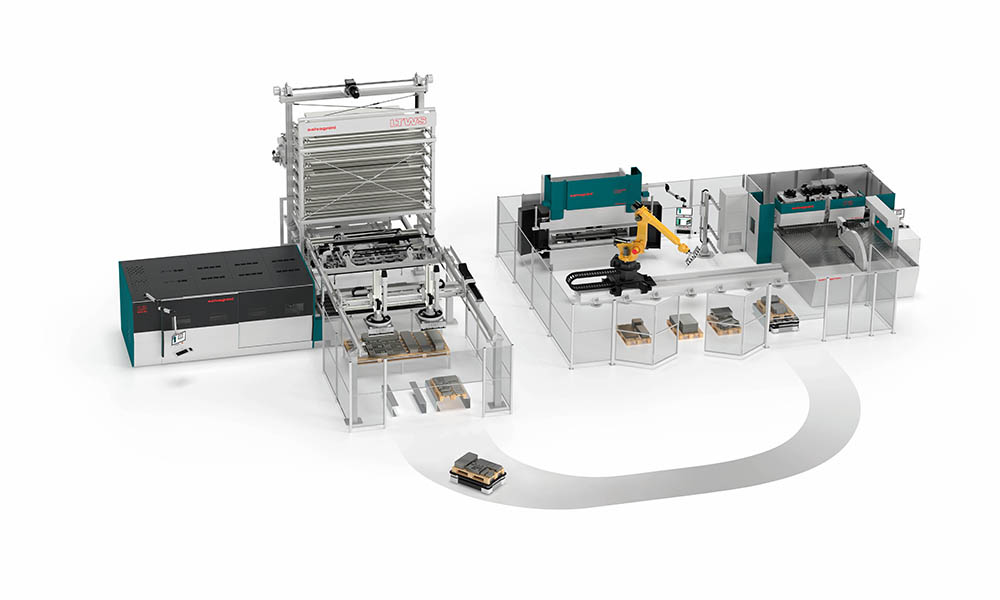
- The Flexible Smart Job Shop coordinates L3.G4, LTWS, MCU, intralogistics with autonomous mobile robots, P-Robot P2-2520HG and B3 when required by production.
- APVS, a world preview, integrates artificial vision with APC2 to strengthen process control and laser cutting autonomy.
- MCU extends the application range and manages thicknesses from 0.5 to 20 mm and weights up to 90 kg for each manipulator, which becomes 180 kg when the two gripping devices work together.
- For the first time, P-Robot integrates a 135 ton, 3000 mm B3.ATA press brake downstream of the P2-2520HG panel bender.
- The P4-3126 panel bender reaches a bending height of 260 mm and integrates the DPM-I, EPP, CUT, CLA/SIM, RSU options and a magazine with three T tools.
Flexible Smart Line S4+P4: the automated production line that manages complexity in a single flow
The exhibition in Hanover is the ideal opportunity to see the FSL S4+P4 line in action. Born in 1979 from the integration of an S4 punching-shearing center and a P4 panel bender, for almost 50 years it has been a versatile, modular sheet metal working solution.
This line produces different parts in sequence and completely automatically, adopting a range of production strategies with the FLOW software. Without WIP, manual set ups and sheet metal handling by the operators, FSL can guarantee the continuity of the production flow, improve the balancing of the various operations, manage the reordering of the parts leaving the system, optimize logistics and support assembly activities.
The line on display at EuroBLECH 2026 has a compact layout: the MD single-sheet store-tower feeds the S4 punching-shearing machine. An MCU Cartesian manipulator positioned between the S4 and P4, can unload and stack the parts, feed the panel bender and balance the various operations, acting as a buffer when needed. The parts being machined pass quickly from one workstation to the next without interruption, minimizing through-times and optimizing factory efficiency.
FLOW: the MOM that makes the Flexible Smart Line more visible, adaptive and intelligent
In an integrated line, what counts is not only the performance of the individual technologies: it is also the ability to manage the flow, adapt it to production priorities and make it readable in real time. And this is where FLOW, the MOM (Manufacturing Operations Management) solution developed by Salvagnini to manage the Flexible Smart Line, comes into play. FLOW is the software that connects the integrated devices in the line and coordinates their production behavior. The operator has an overview of the system from any FACE human-machine interface available on the machine, and can manage all the various technologies involved.
FLOW manages the production strategies of the line according to a two-level logic. The first is Line, the standard configuration of FLOW, which makes available three production strategies: Inline, Stack and Load. The second is Smartline, the optional FLOW level that adds two advanced strategies, Smart Buffering and Smart Reordering, to make the line even more intelligent and flexible in managing jobs and WIP. When launching production order by order, the user can select the most suitable strategy for the operational target.
In addition to the ability to manage strategies, the software also offers simulation capabilities. In the office, FLOW-Office makes available a digital twin of the production system, used for the offline simulation of the actual line behavior as the production strategies vary. Without using the system, materials or tools, job queues and various scenarios can be compared, assessing their impacts and selecting the most effective set-up before launching production. FLOW therefore translates into the physical integration of S4, MCU and P4 into a controllable, adaptable and data-driven production strategy.
S4: punching, reduced consumption and application versatility
S4 is a Generation 4 punching-shearing machine that maintains the classic Salvagnini architecture, with the multi-press head with die-structure and integrated shear. It is equipped with advanced hybrid actuators, a proprietary solution of proven reliability that, compared to electric actuators, reduces average consumption by up to 20%, contributing to more energy-efficient production.
It can hold up to 117 thick turret tools in B, C (maximum force 20 t) and D (maximum force 30 t) type stations, all with 9 mm punch sharpening margin always available over the whole workable sheet. The clearance between the upper and lower part of the head is 18 mm. To maximize versatility, the head can have up to 10 hollow cylinders to use as lower cylinders or traditional punching stations. This head can also hold Multitools allowing the use of 3 forming devices on the same station. Each forming device can be enabled individually with no constraint to respond to different machining needs.
The availability of the tools, actuated individually, helps reduce set-ups and improve production continuity. The patented optic stroke control system maximizes machining quality while extending the range of jobs available, including offsets, ribbing and tapping. Compared to classic turret architecture, the head is extremely accessible, for simple, fast and ergonomic extractions and tool changes.
The integrated shear is composed of two 500 mm blades, which are independent and orthogonal to each other, equipped with blankholders, for cutting any length. This solution reduces cycle times compared to separating with a punch, does not erode the material and minimizes scrap. The proprietary Punch&Cut algorithm optimizes the cycles, separating the individual parts being machined in sequence quickly, flexibly and automatically.
The manipulator has adaptive behavior: the dynamics vary according to the workpiece and the thermal gradients developed during machining. Its grip is extremely reliable, reducing the number of regrippings and the cycle time. It is the only machine on the market with nine independently opening and closing pincers, which extend the possibility to process nests with no holding scrap, drastically improving nesting efficiency and reliability in continuous forming.
An optional tapping unit, which can hold up to 6 different tools, can be installed on the punching head side to further increase the system capacity without reducing the multi-press head’s tooling space.
To ensure full production traceability, three options are available for labeling, ink printing or laser marking of the machined parts in cycle. S4 is programmed using STREAMPUNCH, the software in the STREAM suite devoted to punching technologies. Installed in the office programming station, the software processes the DXF drawings, automatically generating the machine programs for each part and creating the production nests. STREAMPUNCH is used to program all the distinctive functions of S4 in the best way, including controlled tool descent, while also implementing many new functions.
MCU and NEXUS: sorting, buffering and traceability
In the FSL, the MCU sorting device plays a key role: it unloads, stacks, transfers, feeds, re-orders and balances all the line technologies. It can manage parts with different shapes, sizes, weights and destinations, organizing them in line with the selected production strategy and ensuring their traceability.
NEXUS, the Salvagnini software used to program automatic Cartesian sorting devices, processes sorting programs consistently with the required flow. Its automatic algorithms optimize grips and movements and minimize stacking times. Its first strength is simplicity: the operator can interactively edit the programs, checking the grips, unloading sequences, stacks, stacking strategies and destination areas. This fine-grained management runs from the whole job to the single sheet.
FLOW makes NEXUS available in the various FSL interfaces according to the role played by MCU in the station where it is managed. Downstream of the S4, it is able to organize the stacking of the outgoing production. From the MCU station, it is used to manage both the unloading of production from the S4 and the loading of that towards the P4. From the P4 station, for example when using the panel bender in stand-alone mode, it is used to manage sheet metal loading from packs. In this configuration MCU is not only a stacking and transfer automation, but a key element that makes the line more coordinated, flexible and reactive.
P4-3126: automatic panel bender with 260 mm bending height and extended application range
P4-3126 completes the Flexible Smart Line on show at EuroBLECH 2026. This Generation 4 panel bender reaches a maximum bending height of 260 mm and comes with a rich configuration, designed to show the maximum operating flexibility of Salvagnini panel bending.
Like all Salvagnini panel benders, the P4 natively combines productivity and flexibility. Productivity comes from the automatic handling and bending cycles. Flexibility is guaranteed by the universal bending tools, which require no manual retooling. The upper and lower blades, the counterblade and the blankholder are designed to process the whole range of machinable materials and thicknesses. The ABA automatic blankholder adapts the tool length according to the size of the part being produced in-cycle, without machine down times.
The model on show also integrates numerous options used to extend the application range of the panel bender while maintaining high production flexibility. The best known of these are certainly the CUT and CLA/SIM options. The first is used for the automatic and sequential cutting of profiles of different shapes, starting from a single metal sheet, while the second makes available auxiliary blades with automatic modular length, available in both positive and negative versions, to make tabs or bends that are shorter than the whole sheet length. In addition, the RSU option, which helps the panel bender to use auxiliary tools for deburring, engraving or, in this case, for ribbing.
But the P4-3126 is also equipped with EPP, to complete bends on very narrow or complex profiles, and DPM-I, an independent auxiliary sheet metal handling system that introduces an alternative and complementary gripping method to the classic panel bender manipulator. DPM-I is not coupled to the manipulator and adds degrees of freedom in part management: it assures a grip both on already bent sides and sides still to be bent, using a combination of pincers and suction cups. This architecture is used to create narrow profiles and parts that require specific handling, extending the type of feasible parts without involving different technologies.
Finally, its tool magazine is equipped with three T tools that are engaged and disengaged beneath the blankholder, rapidly and automatically. The T tool can also be changed even during the same work cycle. Depending on the part to make the T tool can be used for narrow profiles, CUT profiles, as well as tubular, hidden and radius bends, with intrusive embossings or machining requiring specific auxiliary geometries.
All these options are however not mutually exclusive: working side by side, they allow the panel bender to progressively manage different applications without introducing manual retooling, increasing the variety of parts that can be made and the ability to automatically shift from one shape to another.
CUT+STREAMBEND - Panel bender with nest bending
The P4-3126 on show in Hanover is programmed with STREAMBEND, the specific software for panel bending technologies. Like all the software in STREAM, the Salvagnini programming suite, STREAMBEND is used to program a single part or series of parts completely automatically, even starting from an assembled finished product.
With the CUT option, STREAMBEND automatically manages the programming of identical or different profiles, which can be grouped by material and machining thickness or can be produced together with a panel.
STREAMBEND is used to program CUT profiles in three different ways:
- in manual, leaving the operator the task of adding one or more identical profiles to the base panel, aiming to optimize scrap or work in kit mode;
- in automatic, automatically aggregating a multiple of identical profiles for handling the sheet metal during bending;
- in nestmode, automatically aggregating profiles of different shapes and sizes; in this mode, the algorithm seeks to optimize the cycle time in the panel bender, and also to maximize process reliability; if the notch is produced with an in-line S4 punching-shearing machine, STREAMBEND composes the nest so that the starting format is correctly punched and transferred to the panel bender. Unique to the market, this method allows the panel bender and the line to produce profiles with an MTO (make-to-order) logic, increasingly in demand in todays industrial production dynamics.
The FSL demos: FLOW strategies applied to different industrial sectors
The demonstrations of FSL S4+P4 planned for EuroBLECH include some applications able to demonstrate how the same technical solution can respond to different production needs.
In a demo dedicated to the door and frame sector, the line produces different door/frame kits: from the most complex, with integrated seal, to the simplest. The components have different geometries and are made from different materials and thicknesses using the DPM-I and CUT options. FLOW uses the Smart Reordering strategy to manage the part outfeed sequence, parking and releasing components according to the assembly needs of the various kits in production, exploiting the line to optimize downstream logistics.
In a demo dedicated to the HVAC sector, the line produces some sandwich panels for HVAC plants, consisting of an external half-shell in prepainted sheet metal and an internal half-shell in galvanized sheet metal. Also in this case, FLOW uses the Smart Reordering strategy to reorder and couple components in different materials without operator intervention, facilitating their identification and assembly.
In a demo dedicated to the metal furniture sector, FLOW manages the production of a modular cabinet in Inline mode, exploiting some of the P4 options: RSU for ribbing, CUT for the door leaf, and two T tools in the same bending cycle. With this production, the capacity of the P4-3126 to integrate different auxiliary machinings without manual retooling are exploited to the full.
In a demo dedicated to the electrical sector, the FSL produces a box made of three different part, with a 260 mm bending height and holes for rack elements. The product is designed to minimize assembly and improve sheet metal use efficiency. FLOW manages production in Smart Buffering mode, helping to balance machining times and the overall flow.
Together, the demos make Lead the Change tangible: the same line does not impose a single production mode, but adapts strategies, sequences and flow management to different products, materials and priorities. For those managing production, this means being able to use the same system for variable jobs and kits, maintaining the order required by the downstream operation and reducing manual reorganizations.
Flexible Smart Job Shop: an FMS for independent and collaborative production
Alongside the Flexible Smart Line, at EuroBLECH 2026 Salvagnini presents a Flexible Smart Job Shop, a factory solution combining stand-alone technologies able to cooperate to manage convergent production when necessary.
This FSJ consists of:
- the L3.G4laser, recently awarded the Good Design Award, in a fully automated configuration, with LTWS store-tower and MCU sorting device;
- intralogistic management integrated with autonomous mobile robots that transfer the cut parts downstream;
- P-Robot, the application combining a P2-2520HG panel bender, a robot and a 135 ton, 3000 mm B3 press brake with ATA and ATA.L devices for the set-up of upper and lower bending tools.
- a coordinated set of software and digital systems: STREAMfor programming and nesting, STORE for store-tower management, NEXUS for sorting device management, MOVE and RVS for P-Robot autonomy.
The result is a production system with a high level of automation, in which laser cutting, sorting, logistics, robotised panel bending and bending form a coordinated path, from sheet to finished part.
Flexible Smart Job Shop adopts an integration logic triggered by production needs. MCU organizes the parts leaving the laser according to downstream needs, the independent mobile robots transfer them and RVS helps the P-Robot to recognize and process heterogeneous and different parts in sequence. The continuity between the operations reduces handling and intermediate waiting, limiting the dependency on manual interventions.
In this way, FSJ translates Lead the Change into an adaptable factory logic: the technologies maintain their own stand-alone operation and are coordinated only when and where required by production.
L3.G4: high power density, maximum autonomy and advanced automatic sorting
L3.G4 is the Salvagnini fiber laser cutting system designed to combine high accessibility, high rigidity, efficiency and completely simple use. In the configuration on display at EuroBLECH 2026, L3.G4 integrates a 10 kW high power density source, a 10-tray LTWS store-tower, MCU automatic sorting device and new artificial vision features.
High power density can be considered one of the distinctive features of the Salvagnini lasers. It helps to increase performance especially with average thicknesses, maintaining high cutting quality while optimizing consumption, running costs and production continuity. Its energy efficiency is close to 50%, making it extremely advantageous in terms of financial sustainability: reducing the power while keeping the cutting speeds high means reducing energy and gas consumption for the same performance.
L3.G4 features a wide range of advanced process control and efficiency solutions, which improve performance and make it a highly productive, versatile and easy-to-use laser, with reduced power consumption and competitive running costs. The ACUT option allows L3.G4 to cut with suitably treated compressed air. Depending on the source power, ACUT is used to cut thicknesses of up to 20 mm, with productivity similar to that of cutting with nitrogen at significantly reduced costs. Cutting with compressed air is cheaper than with nitrogen, and this is even truer when the cost per m³ of nitrogen increases: the higher the cost of nitrogen, the more cost-effective cutting with compressed air becomes, while maintaining the same cutting quality and accuracy. Also contributing to the sustainability of ACUT is APM2, the new compact, turnkey device which connects directly to the pneumatic system of the factory and ensures the pressure values required for the cutting process.
All the programs and nests with L3.G4 are done with STREAMLASER, the Salvagnini software for the laser world, part of the STREAM software programming suite. STREAMLASER improves material efficiency and reduces costs due to its distinctive features. The OPTI nesting algorithm optimizes the use of the sheet metal, minimising scrap.
APC2 and APVS: artificial vision and adaptive process control
In order to further simplify some activities which are potentially time-consuming or could generate errors or waste – and therefore reduce the overall efficiency of the system – L3.G4 is also equipped with a number of artificial vision applications based on neural networks. These are simple solutions that increase the flexibility of the system and broaden its field of application. SVS recovers sheet metal leftovers to automatically nest new parts, responding to urgent needs or replacing any waste in downstream machining activities. With the multisheet feature, SVS can organize a production list, positioning more than one sheet metal format on the worktable and associating different production programs with a simple drag&drop. NVS checks that the laser beam is centered, and uses the machine learning algorithms to monitor the state of the nozzle and reduce waste. NVS is presented in Hanover with a new interactive management to make it even quicker and easier to use.
Among the world premieres unveiled at EuroBLECH 2026, Salvagnini introduces the new APVS artificial vision application, integrated with APC2. APC2 is the adaptive process sensor that monitors piercing in real time, for greater speed and higher quality. It checks for any cutting losses, and in the event of a fault, stops the process and resumes it with suitably remodulated parameters. It is also used to automatically search for the focal length.
The new APVS adds a further control level based on artificial vision. A camera monitors the process and supports the identification of cutting losses, even in complex operating conditions, extending the APC2 application range. In this way, the system is able to prevent errors, waste and unmanaged interruptions even more effectively.
The aim is not only to increase control but to make the laser more independent, simpler to use and to reset in the event of an anomaly. It is a tangible way of managing process variability: the technology not only performs but also supports the operator in handling variable conditions and, when necessary, in resuming production.
LTWS and MCU: modular, scalable and easy-to-manage laser automation
The LTWS automatic store-tower is designed for unmanned loading, unloading and storage of material. It is compact in size and has extremely short cycle times, up to 50 seconds. Its loading and unloading devices are independent, increasing the process efficiency even in extremely rapid cutting programs. The configuration on display at EuroBLECH is equipped with 10 trays and makes different materials and thicknesses available for just-in-time production, reducing waiting times for sheet metal feeding, and operator dependency. Its autonomy is guaranteed by the availability of material and the STORE software, which identifies the empty loading trays on which to stack the machined material. The optional mixed tray management function is also used to manage any sheet metal packs on wooden pallets. It also exploits the available spaces in the best possible way, in any case with the possibility to manage materials on pallets, delicate materials, or a few sheets in a tray, when needed. The store-tower is also equipped with AB, an optional brush which allows the pallet changer grilles to be cleaned in masked time and which replaces, on request, the traditional brushes of the fork-structure of the unloading device.
The MCU automatic sorting device is used to easily stack parts of different shapes, sizes and weights. The development introduced by Salvagnini in Hanover concerns precisely weight and thickness limits: today MCU can pick up thicknesses of between 0.5 and 20 mm and weights of up to 90 kg for each manipulator, or 180 kg when the two gripping devices work together.
This result, made possible by the combination between the higher sorting device capacity and the new cutting functions that facilitate material extraction, extend the MCU application range, allowing it to manage heavier parts, greater thicknesses and more complex geometries. It can work in multi-gripping mode, picking up several parts in sequence with the same gripping device, or in double picking mode, where two gripping devices descend at the same time to pick up two independent parts, reducing the part pick-up time by over 25%.
Automatic sorting facilitates the work of the operators, who can pick up the parts already stacked without having to separate them, thus greatly reducing the waiting times between the end of cutting and the start of the next phase. The new functions for scrap saturation and guided part recovery make this automation even easier to use. These functions are born from Salvagnini’s practical experience and respond to a very concrete need: to help the operator to manage any situation without losing control of the production flow. Making the cut parts immediately available on AMR, MCU is used to physically integrate the laser with the downstream technologies.
Easy and flexible sorting with NEXUS
NEXUS is the Salvagnini software for programming the MCU automatic sorting devices. Simplicity is its first strength: all the MCU features can be used according to need, reducing intermediate waiting times and assuring maximum reactivity for sorting automation. NEXUS reduces operator entry barriers: minimum training is required to use it, ensuring rapid production start times. This feature makes it easy to manage any unforeseen situations relating to staff availability or turnover.
NEXUS automatically processes the sorting programs, which the operator can change manually to obtain full flexibility. This assures total process control: the operator can edit the gripping, unloading sequences, stacks, stacking strategies and table changes proposed automatically by the software. The control therefore covers the whole production sequence, it can be fine-grained even acting on single sheets, at precise moments of the production cycle. This fine-grained approach is used even to organise extremely variable contexts and batch-one production, extending the control from the single sheet to the whole production sequence.
NEXUS is extremely flexible in managing diversified production scenarios. Programming is done in the office, on board the machine, or in both environments, to meet all needs and requirements as efficiently and effectively as possible. Furthermore, it can adapt its operating logics to dynamic industrial contexts and the production strategy chosen for the specific job, stacking by production order, kit, downstream processing station and so on. Not having to select a production strategy in advance, it is used to manage large batches, small batches, kits and batch-ones according to requirements. In the FSJ context, this flexibility transforms sorting, from a conclusive laser function to a connection point with the technologies downstream: the parts are already organized according to destination and the subsequent machining sequence.
P-Robot: panel bending and bending in a single robotised cell
P-Robot is the Salvagnini application which combines a panel bender with a robot to produce kits, batches and single parts. The one on show at EuroBLECH 2026 is Generation 4 P-Robot that integrates a P2-2520HGpanel bender. It responds to an industrial context marked by high item turnover rates, quick lead-times and constant personnel shortages. Automation and robotisation extend production beyond the traditional manned shifts, while operators can spend time on activities with high added value.
The P-Robot configuration can be customized. Salvagnini offers increasingly integrated and advanced systems that can robotize loading, unloading or loading/unloading operations, improve autonomy, enable kit processing, support automatic material handling or include other technologies, such as corner forming stations, labeling, laser marking, riveting and welding. And this is precisely where the main new feature of the P-Robot on show in Hanover lies: downstream of the panel bender, for the first time, a 135 ton and 3000 mm B3 press brake, with ATA and ATA.L devices for upper and lower bending tool adjustments, is also integrated into the cell.
The combination of P2-2520HG and B3 organizes two complementary technologies in a single sequence, and is used to extend the cell application range to cover the vast majority of panels required. The P2 implements the majority of processing jobs; B3 completes double negative bends, out-of-range bends and secondary forming. The cell flexibility comes not from the mere presence of two technologies, but from their ability to offer a coordinated contribution to completing the same part. This complementarity extends the jobs that can be managed in a single flow, reducing the need to send the part to downstream processes.
Another evolution proposed by Salvagnini at EuroBLECH is the new P-Robot HMI, designed to simplify production management, make the system operating state clearer and resumption following an interruption more intuitive. Reducing operational complexity, it places the operator in the condition to manage the cell autonomy and any unforeseen situations more immediately.
RVS: artificial intelligence serving the cell
P-Robot is equipped with all the devices that have crowned its success: these include the flippable gripping device, with suction cups on both sides, which automatically adapts to the size of the part to be handled, and MOVE, the on-board software that acquires the panel bending program, calculates the size of the flat part and the finished panel and uses it to automatically process the robot trajectories. MOVE also independently manages the intermediate movements, reducing the activities required from the operator and avoiding the need for offline robot programming.
But one of its distinctive functions remains the RVS, Robot Vision System. This patented artificial vision system simplifies the use of the technology, optimizing the intermediate steps of recognition, handling and programming, increasing process quality.
With RVS, P-Robot recognizes and processes the parts autonomously. With cameras and sensors, the artificial vision device acquires an image of the surrounding environment and interprets it using artificial intelligence. RVS recognizes the parts, distinguishes the single sheets, and identifies the position of pallets and stacks without references. This information is shared in real time with the panel bender and the robot, which adapt autonomously to ensure that the sheet metal is handled and positioned precisely.
RVS is used by the P-Robot to manage different production methods, optimizing cycle times and eliminating sheet metal centering ahead of production. It increases the cell flexibility and is used to handle parts with complex shapes or that cannot be centered using gravity centering devices.
In the Flexible Smart Job Shop on display at EuroBLECH 2026, RVS becomes the connection between the variability generated upstream and the autonomy of the cell downstream. It automatically recognizes heterogeneous stacks coming from the laser and helps the P-Robot to manage the parts in sequence and without interruption. In this way, the robotics adapt to the actual production flow without being bound to a rigid system, typical of large, cheap batches.
P2-2520HG: the panel bender for high-thickness machining
Another new feature is the P2-2520HG panel bender integrated into the cell, the most recent of the six models available on the P2 platform. The machine extends the possibilities of compact panel bending, and, in specific conditions and depending on the breaking strength of the material, can bend thicknesses of up to 5 mm for aluminum, 3.2 mm for stainless steel and 4.2 mm for mild steel.
Like all Salvagnini panel benders, the P2 natively combines productivity and flexibility. It requires no manual retooling because the upper blade, lower blade, counterblade and blankholder are universal tools. The ABA automatic blankholder adapts the tool length according to the size of the part being produced in-cycle, without machine down times.
P2 helps to eliminate waste and corrections, automatically adapting to the variations in the mechanical and geometric characteristics of the sheet metal being machined. MAC3.0 detects any differences in the mechanical characteristics of the material compared to their nominal value during the cycle, adapting the movements of the bending unit and the manipulator to compensate them. The panel bending program is done with STREAMBEND and can be used without the need for changes on both the P-Robot and on the standard robotless panel benders.
B3: the press brake that completes the cell
The 135 ton and 3000 mm B3 press brake completes the Flexible Smart Job Shop on show at EuroBLECH 2026. Equipped with ATA and ATA.L devices for upper and lower bending tools, it automates the set-up to recover production times and efficiency.
In the FSJ context, it acts as a complementary technology for the panel bender, performing jobs that are not included in the panel bending process, including negative bends, double negative bends, out-of-range bends and secondary forming to be done after other forming and bending operations. The press therefore extends the production feasibility of the cell, and is used to complete complex parts in an automatic and coordinated manner.
ATA is the patented device that automatically adjusts the length of the upper bending tools. ATA.L extends this logic to lower tools. The change takes place in just a few seconds and supports dynamic production jobs, kits and sequences in which one part may be different from the next. The possibility to make one or more ATA changes in-cycle confirms the vocation of the B3 of blending productivity and flexibility.
What also make the B3 particularly interesting are the technical solutions such as Direct Drive, which controls the ram movements with a pair of independently operating direct transmission brushless motors, for rapid, precise movements. B3 also integrates MAC3.0, a set of adaptive technologies that reduce waste and corrections. S-Crowning guarantees bends at a constant angle along the entire length. TFC2.0 compensates any structure deformations according to the part being machined. AMS measures the bending angle and corrects any variations due to sheet metal springback.
Programming can be done on the machine, but programming in office maximizes efficiency. STREAMFORMER automatically creates bending sequences, set-ups and bending stations, integrating with ATA and ATA.L and contributing to the operational continuity of the Flexible Smart Job Shop.
Services: the partnership accompanying the system life cycle
The value of a Salvagnini system does not end with installation: during its operational life, it continues to generate efficiency, capacity and competitive performance, provided that it is used, services, upgraded and integrated consistently with the development of the production organization. This is why Lead the Change does not only concern the new technologies on show at the exhibition. It also concerns the ability to enhance and develop the production potential that many companies have at their fingertips in the installed machine inventory.
For many customers, especially those who over the years have built a complex machine inventory, there is unexpressed potential that is not always immediately visible: production capacities not used to the full, processes that can be rationalized, skills to be updated, flows to be redesigned, automations to exploit better, software to be integrated more effectively into the day-to-day factory logics. Salvagnini can help this value to come to the fore, making available not only technologies, but extensive industrial experience in many different sectors.
In this perspective, services become an integral part of the Salvagnini offer. Not a catalog of after-sales interventions but a structured partnership accompanying customers from pre-sales to sale, from training to service, from starting production to the future developments of the system. Salvagnini has industrialized these phases to turn them into a continuous process: analyzing, configuring, installing, training, servicing, upgrading and improving. This continuity helps to obtain greater value from what is already installed and reduce the distance between the theoretical potential of the system and the actual result generated by the system everyday in the workshop. It puts the customer into the position of being able to use the technologies better, transferring skills to personnel, coping with turnover, preventing inefficiencies and preparing the evolution of their own factory.
The Salvagnini offer is built aroundthree levels, ACT, PLAN and GROW, which correspond to three complementary modes of managing change: reacting to operational needs, planning production continuity and enhancing skills, processes and performance. ACT helps to tackle day-to-day needs. PLAN is used to prevent problems and preserve system value over time. GROW supports the development of the organization, helping the customer to develop know-how, improve processes and fully exploit the production potential already available.
This arrangement turns Salvagnini services into a strategic lever. Because the future of the factory does not only depend on new machinery or new automation, but on the ability to integrate technology, method, skill and operational continuity in a sustainable growth path. Managing change also means this: choosing a partner who is able to accompany the company over time, helping it to turn its technological assets into measurable production value.
ACT: reacting to operational needs
ACT includes services designed to promptly respond to the customer’s day-to-day needs. This level includes remote supporting tools, software services, telephone assistance and on-site service. Acty is an augmented reality application that provides remote intelligent assistance. LINKS is used to monitor performance, production data, logbooks, KPIs, telemetry and parameters through Condition Monitoring, making deviations and conditions that may impact the operational continuity of the system more visible. SupportYou simplifies the programming software management, providing upgrades and support and migrating the licenses.
ACT is the level that helps the customer to cope rapidly with operational challenges, reducing downtimes and maintaining high system availability.
PLAN: preventing and planning
PLAN focuses on organizational management, on prevention and on strategic planning. It includes maintenance contracts, overhauling services, transfers and maintenance kits.
Maintenance contracts are designed to ensure that the machines maintain maximum productivity over time. Overhauling services are used to replace or recondition worn components, improve performance and overcome problems linked to technical obsolescence. Transfers are used to move systems within the same plant or to new sites, minimizing downtimes and preserving operational continuity. Maintenance kits help the customer to manage stocks of spare parts and technical materials required to cope with sudden failures.
PLAN translates the ability to look beyond emergencies into a service, anticipating problems and protecting the value of the investment. In integrated systems, planning maintenance, servicing and the availability of spare parts also helps to reduce the risk of the unavailability of a single technology conditioning upstream or downstream operations.
GROW: developing skills and processes
GROW promotes the continuous improvement of processes and the development of internal skills. In a context in which turnover reduces knowledge continuity in the workshop and the technical departments, training and transfer of know-how become key elements for obtaining value from the systems.
Rethinks places the knowledge and skills of Salvagnini specialists at the disposal of businesses, to exploit the potential of their plants to the full. It includes design courses for designers and design support activities, aiming to reduce waste, optimize the production process and improve product quality.
TrainingMate offers training program for machine operators and maintenance technicians. StudyMate provides feasibility studies, detailed reports, ready-to-use programs and, if necessary, assistance for starting production.
GROW interprets service as evolution. It helps the customer to improve skills, processes and production strategies, turning the relationship with Salvagnini into a long-term partnership.
Together, ACT, PLAN and GROW extend integration beyond the system: data, service, maintenance, flow analysis and skills help to maintain coherent technologies and processes even when the mix, priorities and production organisation change.